CNT Conductive Material: How Carbon Nanotubes Are Changing Battery Technology
Related Topics
Discover how CNT conductive material is transforming battery performance with superior electrical conductivity, high aspect ratios, and energy density benefits for lithium-ion batteries.
Follow us on
Battery technology keeps getting better, and CNT conductive material sits at the heart of recent breakthroughs. We're seeing carbon nanotubes (CNTs) transform how batteries perform, especially in electric vehicles and energy storage systems. These tiny cylindrical structures—just nanometers wide—pack a serious punch when it comes to electrical conductivity and mechanical strength.
What Makes CNT Conductive Material Special
Carbon nanotubes are hollow tubes made from rolled-up sheets of graphene. Think of them as incredibly thin straws, with diameters measuring only about 1 nanometer—roughly 100,000 times thinner than a human hair. But don't let their size fool you. CNTs boast electrical conductivity comparable to copper and tensile strength about 100 times that of steel.
The real magic happens because of their structure. These one-dimensional materials come in two main types: single-walled carbon nanotubes (SWCNTs) with a single graphene layer, and multi-walled carbon nanotubes (MWCNTs) with multiple nested layers. Both types deliver excellent electrical properties, but SWCNTs typically show higher electrical conductivity and larger specific surface areas, making them particularly attractive for battery applications.
How CNT Conductive Additives Work in Batteries
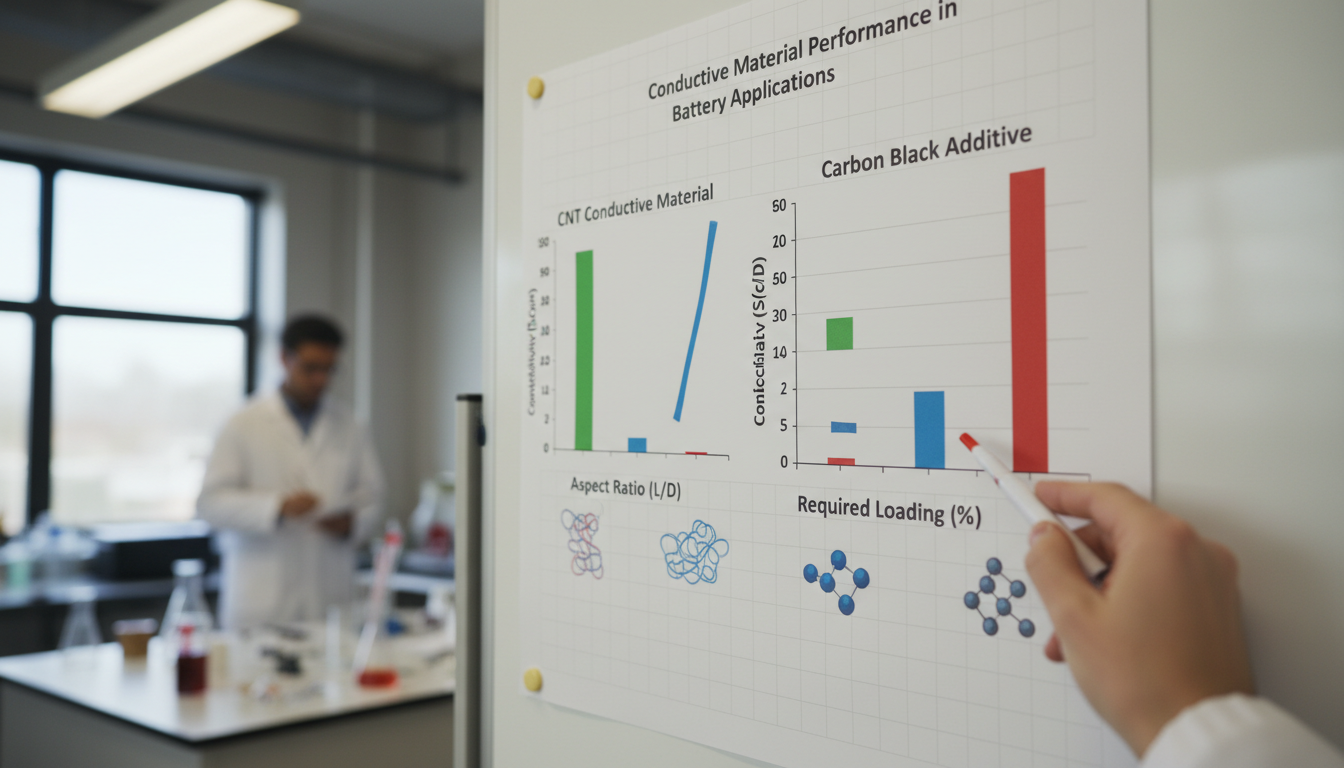
We use CNT conductive material as additives in battery electrodes to create efficient pathways for electron movement. Here's where their high aspect ratio—roughly 1000:1—becomes a game-changer. This means you need far less CNT material compared to traditional conductive additives like carbon black to achieve the same conductivity.
In fact, CNT-based conductive additives can cut the necessary amount in cathodes to about one-fifth of what carbon black requires. This saved space? You can fill it with more active materials, directly boosting energy density. At Highstar, we understand how these materials work together to create better battery solutions, whether you're working with LFP batteries or ternary lithium systems.
Benefits for Battery Performance
The advantages of CNT conductive material extend beyond just conductivity. Their large specific surface area and high aspect ratio allow them to form three-dimensional conductive networks that connect active materials throughout the electrode. This network structure delivers several benefits:
Faster charging rates – The excellent electron transport enables rapid charge and discharge cycles, which matters for electric vehicle applications where charging time affects user experience.
Better cycle life – CNTs form mechanically robust networks that buffer volume changes in active materials during charging and discharging. This becomes especially valuable with silicon-based anodes, which expand and contract significantly during operation.
Higher energy density – Since you need less conductive additive material, more space becomes available for energy-storing active materials.
The mechanical flexibility of CNTs also minimizes structural deformation over repeated charge-discharge cycles, preventing the performance degradation that plagues conventional materials.
Applications in Modern Battery Technology
CNT conductive material has found its way into multiple battery applications. In cathodes, CNTs boost electrical conductivity while improving structural stability through bonding with cathode materials. This combination increases both performance and lifespan.
For anodes, particularly silicon-containing ones, CNT additives maintain strong conductive networks despite silicon's notorious expansion and contraction issues. The high-capacity silicon active material also allows for thinner electrodes compared to conventional graphite, making batteries more suitable for fast charging applications.
Researchers have also developed CNT-based materials for next-generation batteries, including all-solid-state batteries and dry-process electrode manufacturing. These eco-friendly manufacturing approaches reduce the need for toxic organic solvents and energy-intensive drying processes.
Challenges and Future Developments
While CNT conductive materials offer impressive benefits, they come with challenges. CNTs tend to aggregate and tangle together, making uniform dispersion in battery materials tricky. Getting them to mix well with other electrode components requires careful processing.
Recent breakthroughs have addressed some dispersion issues. Researchers developed powdered, highly dispersible CNT conductive additives specifically designed for dry battery manufacturing processes. This innovation opens doors for more environmentally friendly production methods while maintaining the performance advantages CNTs provide.
Cost remains another consideration. Producing high-quality CNTs at commercial scale costs more than traditional materials like carbon black, though prices continue dropping as production methods improve and volumes increase. Some estimates suggest the CNT-based conductive additives market will grow from $370 million in 2021 to $1.91 billion by 2027.
Optimizing CNT Materials for Different Applications
Not all CNTs perform equally in every situation. Several factors affect their electrical performance: synthesis method, diameter, length, alignment, purity, and surface characteristics. Single-walled CNTs generally offer higher conductivity than multi-walled versions, but MWCNTs bring advantages in mass production, lower cost, and better thermal and chemical stability.
Surface modification techniques can further improve CNT performance. Treatments like ozone exposure or chemical functionalization change surface properties, improving dispersion and interfacial interactions with other battery materials. These modifications can boost electrochemical performance, especially in high-loading electrodes for demanding applications.
Conclusion
CNT conductive material represents a significant advancement in battery technology. With electrical conductivity rivaling copper, mechanical strength exceeding steel, and the ability to form efficient conductive networks at low loadings, carbon nanotubes are helping push battery performance to new levels. From extending cycle life to enabling faster charging and higher energy density, CNTs address multiple performance challenges simultaneously. As production costs decrease and processing techniques improve, we expect CNT-based conductive additives to become increasingly common in commercial battery applications, driving better performance for electric vehicles, consumer electronics, and grid-scale energy storage systems.
Frequently Asked Questions
What is CNT conductive material?
CNT conductive material refers to carbon nanotubes used as conductive additives in various applications, especially batteries. These cylindrical carbon structures, measuring just nanometers in diameter, provide excellent electrical conductivity and mechanical strength. They're typically added in small amounts to battery electrodes to create efficient pathways for electron movement, improving overall battery performance.
How does CNT improve battery performance compared to carbon black?
CNTs require only about one-fifth the amount of carbon black to achieve similar conductivity levels due to their high aspect ratio of roughly 1000:1. This means more space for active materials, resulting in higher energy density. CNTs also form stronger mechanical networks that better handle volume changes during charging cycles, extending battery lifespan and enabling faster charging rates.
What's the difference between single-walled and multi-walled carbon nanotubes?
Single-walled carbon nanotubes (SWCNTs) consist of one graphene layer rolled into a tube, offering higher electrical conductivity and larger surface areas. Multi-walled carbon nanotubes (MWCNTs) have multiple nested layers, providing better mechanical strength, easier mass production, lower costs, and improved thermal and chemical stability. The choice depends on specific application requirements and budget considerations.
Why are CNTs particularly good for silicon-based battery anodes?
Silicon anodes expand and contract significantly during charging and discharging—up to 300% volume change. CNT conductive additives maintain strong conductive networks despite this expansion and contraction, which traditional additives can't handle well. This maintains electrical connectivity throughout charge cycles, substantially improving cell lifespan and enabling the use of high-capacity silicon materials.
Are CNT-based batteries more expensive?
Currently, CNT materials cost more than traditional conductive additives like carbon black. However, you need less material to achieve better performance, which can offset some cost differences. As production scales up and manufacturing techniques improve, prices continue dropping. The performance benefits—longer life, faster charging, higher energy density—often justify the additional upfront cost for premium applications like electric vehicles.
Highstar attaches great importance to your personal privacy. When you visit our website, please agree to the use of all cookies. More information about the processing of personal data can be found at "Privacy Policy"


 Buy
Buy