Electrolyte Additives for EV Batteries: How Small Molecules Make a Big Difference
Related Topics
Discover how electrolyte additives boost EV battery performance, safety, and lifespan. Learn about film-forming additives, SEI layers, and the latest innovations in battery technology.
Follow us on
Electric vehicles need batteries that last longer, charge faster, and stay safe under demanding conditions. But here's something most people don't realize: sometimes the smallest components make the biggest difference. We're talking about electrolyte additives that can make a significant difference with only a small amount. These tiny molecules—often added at just 1-5% by weight—can completely change how your battery performs over its lifetime.
Battery manufacturers like us at Highstar have spent years perfecting electrolyte formulations, and these additives are one of our most powerful tools. They protect battery electrodes, stabilize interfaces, and help cells handle the stresses of daily charging and discharging cycles. Let's break down what these additives actually do and why they matter for the future of electric transportation.
What Are Electrolyte Additives and Why Do They Matter?
The electrolyte in lithium-ion batteries helps lithium ions shuttle between the cathode and anode. Think of it as the highway system that allows charge carriers to move back and forth. The base electrolyte typically consists of lithium salts dissolved in organic solvents—a formula that's worked for decades but has limitations.
That's where additives come in. Electrolyte additives can help extend the life of electric vehicle (EV) batteries by stabilizing the electrode-electrolyte interfaces and mitigating the adverse side reactions that cause battery degradation over time. Instead of completely redesigning the electrolyte, we can add small amounts of carefully selected compounds that dramatically improve performance.
The numbers tell the story. From 2018 to 2022, the annual number of academic papers and patents that employ electrolyte additives nearly doubled, and the proportion of papers on lithium-ion batteries that employ electrolyte additives has steadily grown from 5.8% to 7.4%. This growth reflects how critical these materials have become.
How Additives Form Protective SEI Layers
One primary way electrolyte additives help EV batteries last longer is by facilitating the formation of a stable solid electrolyte interphase (SEI) layer on the anode's surface. This SEI layer is like a protective skin that forms during the first few charging cycles. It needs to be thin enough to let lithium ions pass through but thick enough to block electrons and prevent unwanted chemical reactions.
Here's how it works: additive molecules reduce at a higher potential than solvent and salt molecules during cycling, resulting in the creation of a stable SEI film. By decomposing first, these additives essentially sacrifice themselves to create a better protective layer than would form naturally.
This layer is important because it keeps the anode safe from constant reactions with the electrolyte, which can use up Li-ion and cause the capacity to drop. A well-formed SEI layer is electrically insulating but allows for the efficient transport of Li-ions. Get this balance right, and your battery can last for thousands of cycles. Get it wrong, and you'll see rapid capacity fade.
Our ternary lithium batteries at Highstar benefit tremendously from optimized SEI formation, which is why we pay such close attention to electrolyte composition.
Common Electrolyte Additives Used in EV Batteries
Different additives serve different purposes. Let's look at some of the most common ones you'll find in modern EV batteries:
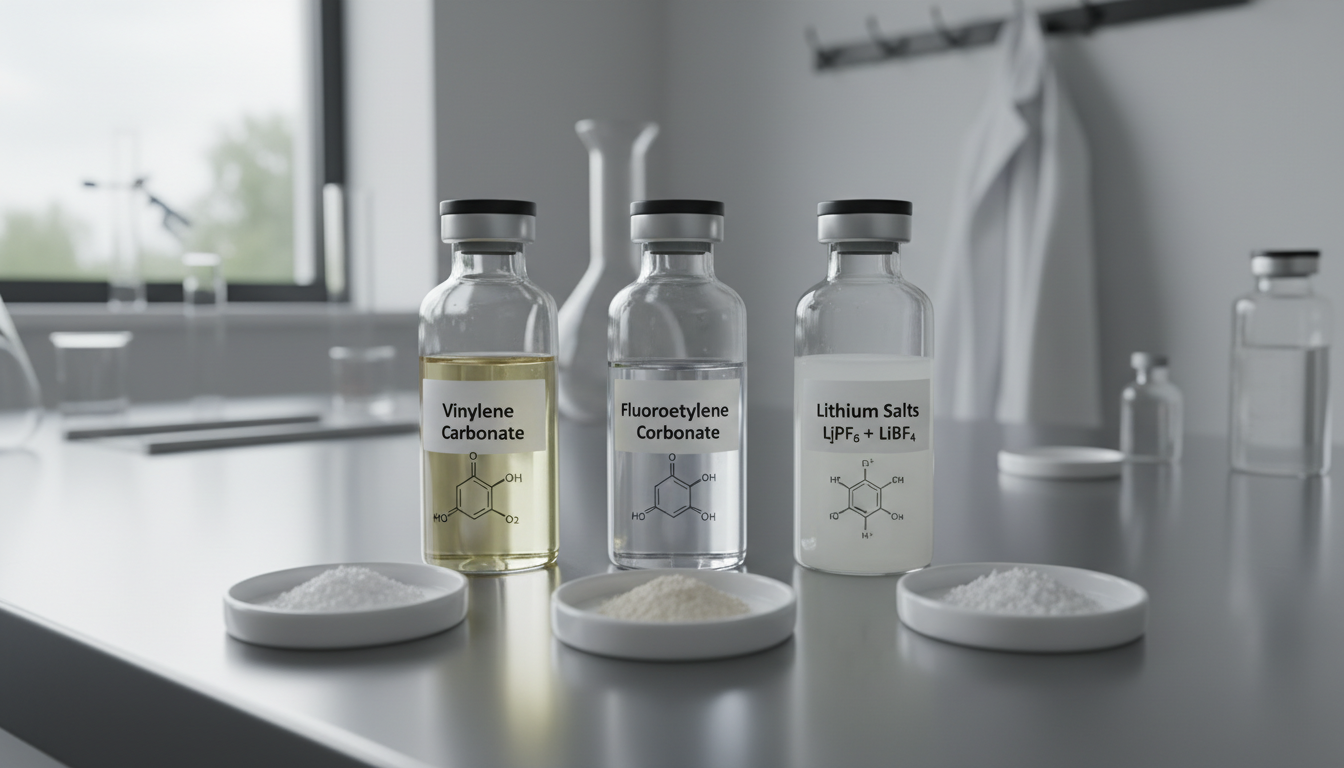
Vinylene Carbonate (VC) is probably the most widely used additive. Vinylene carbonate (VC) is a common electrolyte additive used in EV batteries, which forms a stable SEI layer on the anode. This layer protects the anode from continuous electrolyte decomposition and allows efficient Li-ion transport. It's been a workhorse in the battery industry for years.
Fluoroethylene Carbonate (FEC) is another major player. Fluoroethylene carbonate (FEC) is another common and significant electrolyte additive used in the Li-ion batteries found in EVs. FEC works so well as an electrolyte additive because it breaks down more quickly in the first few cycles. This early decomposition creates fluorine-rich protective layers that are especially effective for silicon-containing anodes.
Lithium salts with special functions round out the mix. For EV batteries, about 5% of LiFSI (F electrolyte), LiPO2F2(P electrolyte), LiDFOP (D electrolyte), and LiBOB (B electrolyte) are added to the LiPF6 for higher performance and longer life. Each brings something different to the table—improved low-temperature performance, better high-voltage stability, or enhanced safety characteristics.
We've tested these additives extensively in our cylindrical cells and prismatic cells, fine-tuning the formulations for specific applications.
Performance Benefits: Real-World Impact
So what do you actually get when you use the right additives? The performance improvements are measurable and meaningful.
VC additive improves capacity retention, clearly outperforming FEC and the additive-free electrolyte. The FEC additive also shows improvement over LP57 but performs worse than VC, which is particularly evident at 100% SoC. Therefore, VC demonstrates clear potential to enhance EV battery lifespan under stressful operating conditions where batteries are kept at high states of charge. This matters because EVs often sit at high charge levels between drives.
Temperature performance is another area where additives shine. The F electrolyte improves output capabilities and extends battery life by inhibiting corrosion. Also, it helps prevent discharge at low temperature. The P and D electrolytes extend battery life, shorten charging time, and help stable operation of batteries at high temperature. The B electrolyte improves output at room and low temperatures and increases the momentary output.
As battery technology advances, additives are becoming even more critical. Silicon anodes, for example, promise much higher capacity than traditional graphite but come with huge challenges. Silicon presents an additional technical challenge, as its substantial volume expansion (up to 300%) during lithiation imposes mechanical stress on the solid-electrolyte interphase (SEI). Therefore, the mechanical properties of the SEI are of utmost importance.
Carbonate additives such as FEC and VC are widely utilized in silicon-composite anodes due to their ability to form robust SEIs. The polymeric components of these additives contribute to a mechanically flexible SEI, while the polycarbonate components offer electrochemical stability, even at elevated temperatures. This flexibility is what allows the SEI to survive the dramatic volume changes without cracking.
High-nickel cathodes present a different set of problems. Manufacturers are turning to high-nickel ternary alloys and manganese-based, lithium-rich metal oxides for lithium-ion battery cathodes. These compounds offer significantly higher energy density and capacity at lower cost, making them a promising solution for advanced EV battery packs. However, these materials have lower thermal stability under high-heat and high-voltage conditions, leading to oxygen release (and electrolyte combustion), metal ion dissolution and HF formation under such conditions.
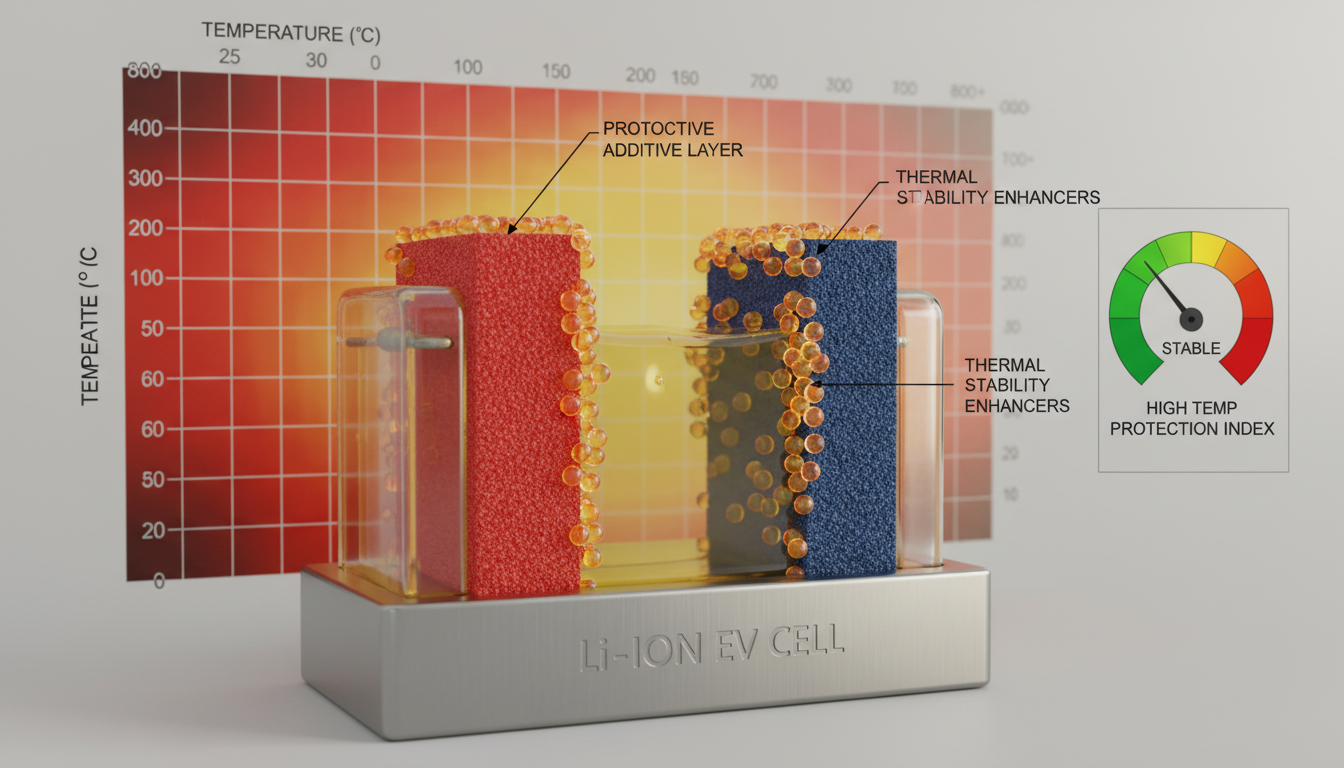
Specialized additives can address these issues. Stanyl® SN-PURE, succinonitrile (SN), is a revolutionary electrolyte additive that enhances the safety and reliability of LiBs by forming a sub-nanometer thick protective layer at the cathode. Electrolytes enhanced with SN additives effectively prevent thermal runaway, remaining stable even when battery chambers are heated to 150°C.
Safety Improvements from Electrolyte Additives
Battery safety isn't just about preventing catastrophic failures—it's about building in multiple layers of protection. Additives contribute to this safety philosophy in several ways.
First, they reduce gas generation during charging. Unwanted side reactions can produce gases that build up pressure inside the cell, potentially leading to venting or worse. The right additives suppress these reactions before they become problems.
Second, they improve thermal stability. Oxidation stability testing revealed that SN additives reduce gas expansion by over 50% during 70 minutes of high-heat exposure. Additionally, batteries containing SN additives maintained consistent capacity after >1000 charging cycles. This kind of long-term stability is exactly what EV manufacturers need.
Third, they help prevent dendrite formation—tiny metallic structures that can grow inside batteries and potentially cause short circuits. Certain additives create SEI layers that discourage dendrite nucleation and growth.
Future Directions in Additive Development
The field of electrolyte additives is far from mature. Researchers continue to discover new compounds and combinations that offer even better performance.
Classical solid electrolyte interphase additives, such as vinylene carbonate and fluoroethylene carbonate, have limited potential for simultaneously achieving a long lifespan and fast chargeability in high-energy-density lithium-ion batteries. Here we report a next-generation synthetic additive approach that allows to form a highly stable electrode-electrolyte interface architecture from fluorinated and silylated electrolyte additives.
Machine learning is accelerating the discovery process. We select and test a diverse collection of 28 single and dual additives for the Gr||LNMO battery system. Subsequently, we train machine learning models on this dataset and employ the trained models to suggest 6 binary compositions out of 125, based on predicted final area-specific-impedance, impedance rise, and final specific-capacity. Such machine learning-generated new additives outperform the initial dataset.
At Highstar, we're investing heavily in next-generation electrolyte technologies for both our lithium-ion and emerging battery platforms. Our 16GWh annual global capacity gives us the scale to test and implement new formulations efficiently.
Conclusion
Electrolyte additives might be small in quantity, but they're absolutely massive in impact. These carefully selected molecules protect battery electrodes, stabilize interfaces, improve safety, and extend lifespan—all with additions of just a few percent by weight. As EV batteries push toward higher energy densities, faster charging, and longer lifespans, additives will only become more important.
The science behind these materials is complex, involving electrochemistry, materials science, and increasingly, machine learning. But the goal is simple: make better batteries that last longer and perform reliably under all conditions. Whether you're designing the next generation of electric vehicles or building grid-scale energy storage, getting the electrolyte formulation right—additives included—is absolutely critical to success.
FAQs
What percentage of electrolyte additives is typically used in EV batteries?
Most electrolyte additives are used at concentrations between 0.5% and 5% by weight. Despite these small amounts, they can dramatically improve battery performance, safety, and lifespan. The exact concentration depends on the specific additive and application requirements.
How do electrolyte additives improve battery safety?
Additives improve safety by forming protective layers that prevent unwanted reactions, reducing gas generation, improving thermal stability, and preventing dendrite growth. Some specialized additives can delay thermal runaway by over 40% and remain stable at temperatures exceeding 150°C.
Can electrolyte additives help batteries work better in cold weather?
Yes, certain additives specifically improve low-temperature performance. F-type electrolyte additives help prevent discharge at low temperatures, while B-type additives improve output at both room and low temperatures. These additives are particularly valuable for EVs operating in cold climates.
What's the difference between film-forming additives and other electrolyte additives?
Film-forming additives decompose preferentially during the first charging cycles to create protective SEI layers on electrode surfaces. Other additives might improve ionic conductivity, scavenge harmful byproducts like HF, or enhance the electrolyte's thermal stability without necessarily forming films themselves.
Are the same electrolyte additives used for both graphite and silicon anodes?
While some additives work for both, silicon anodes have unique requirements due to their massive volume expansion (up to 300%). Silicon-compatible additives must create mechanically flexible SEI layers that can withstand repeated expansion and contraction without cracking, which requires different formulations than those optimized for graphite.
Highstar attaches great importance to your personal privacy. When you visit our website, please agree to the use of all cookies. More information about the processing of personal data can be found at "Privacy Policy"


 Buy
Buy